



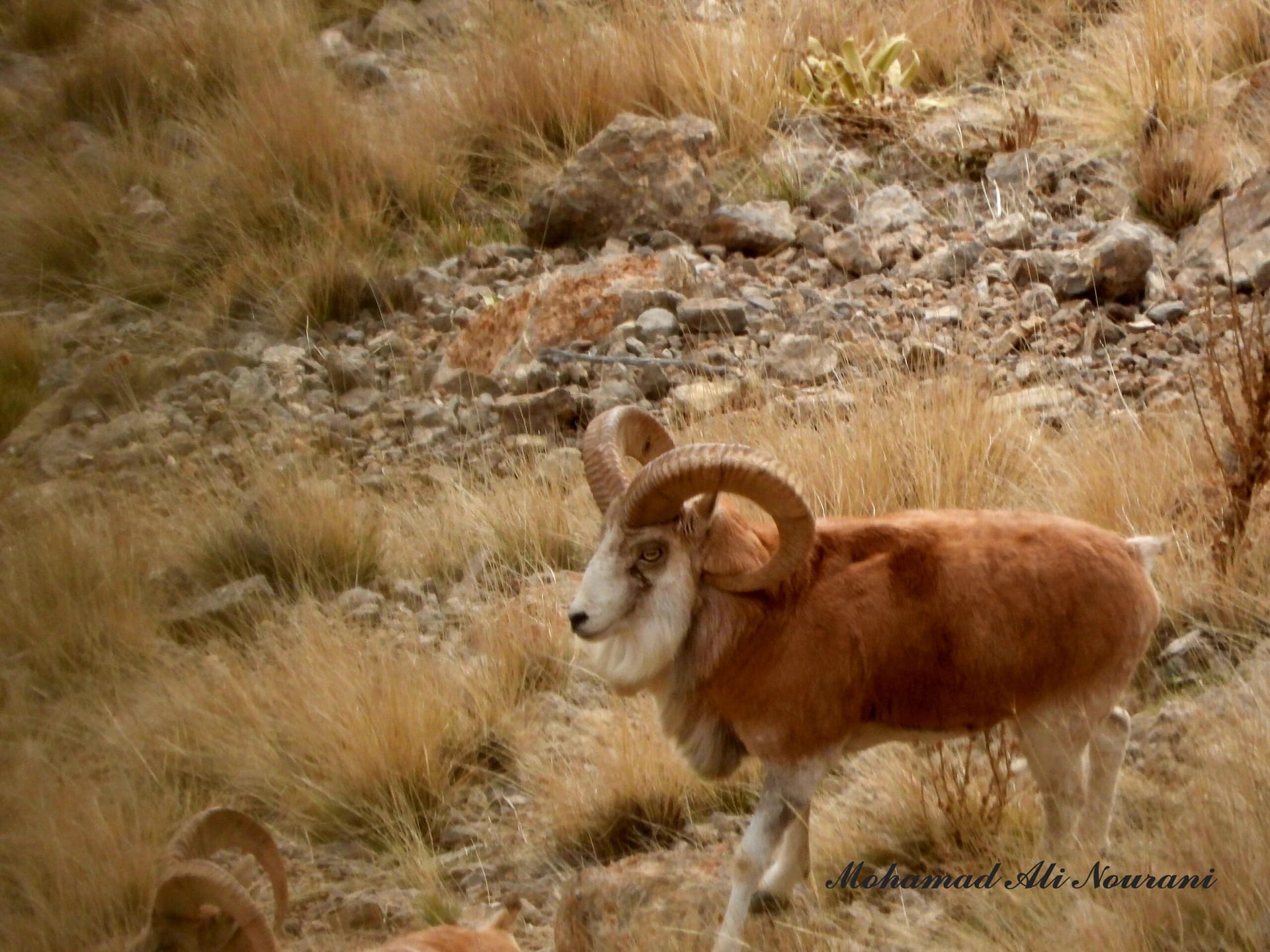
Bezoar ibex

Bezoar Ibex
A robust and highly agile wild goat, adapted to the steep, rocky landscapes of Iran's mountainous regions.
Physical Characteristics
The wild goat is a robust and muscular mountain ungulate with a stocky body and relatively short tail. Its body length ranges from approximately 120 to 160 cm, with a tail length of 15 to 20 cm, a shoulder height of 70 to 100 cm, and a body weight ranging from 25 to 120 kg.
Adult males are distinguished by their long, scimitar-shaped horns, which feature distinct annual growth rings and may reach lengths of up to approximately 152 cm. Females have much shorter horns, usually measuring only a few centimeters.
The coat varies from brownish to yellowish-grey, with males generally darker in coloration than females. Mature males typically develop a prominent beard and a distinctive black stripe extending from the withers down the front of the shoulders and merging with the dark chest area.
As they age, males gradually become paler, with older individuals sometimes developing a cream-white coloration along the sides and flanks. Black hairs are present on the front of the feet, while the coat generally becomes lighter during winter.
Adult males are especially recognizable by their long, curved horns, prominent beard, and contrasting dark markings across the chest and shoulders.
Biology & Behavior
The wild goat is a diurnal, herbivorous ruminant that is highly adapted to mountainous environments. It is a social species with well-developed senses of smell, sight, and hearing.
Females generally live in groups with their young, while adult males tend to form separate groups or remain more solitary, particularly outside the breeding season.
Wild goats are exceptionally agile climbers and are capable of navigating steep, rugged, and precipitous rocky terrain with remarkable ease. In some regions, their seasonal movements are limited to relatively small changes in elevation.
When threatened, wild goats may stamp their feet against the ground and forcefully exhale through their nostrils as a warning response.
Their diet consists primarily of grasses, shrubs, leaves, and other vegetation, with feeding habits varying according to seasonal availability.
Their exceptional climbing ability allows them to move through steep rocky terrain that is difficult for many other large mammals to access.
Reproduction & Life History
The breeding season generally occurs during autumn. Following a gestation period of approximately 150 to 160 days, females typically give birth to one or two kids.
Newborns usually weigh around 3 to 4 kg and may nurse for approximately 4 to 5 months.
Young goats have soft, silky, yellowish-grey coats, with darker hair around the face and the front of the feet. Their horns are initially shorter than their ears and gradually develop as they mature.
Wild goats generally reach adulthood at around 2 to 3 years of age. In captivity, individuals may live for approximately 12 to 15 years.
Ecological Role & Predators
Wild goats form an important part of mountain ecosystems and interact with their environment through grazing and browsing on available vegetation.
Natural predators include wolves, leopards, and cheetahs, while birds of prey and hyenas may also prey upon young individuals.
Habitat & Distribution
The wild goat is strongly associated with mountainous and rocky landscapes and is distributed across a wide range of suitable mountain habitats in Iran.
Its ability to navigate steep slopes, rocky cliffs, and rugged terrain allows it to occupy areas that are often difficult for many other large mammals to access.
Conservation Status
The wild goat is classified as Vulnerable (VU) on the IUCN Red List.
This status reflects conservation concerns surrounding the species and highlights the importance of protecting its natural habitats and maintaining sustainable wildlife management practices.
Share This Article


Comments
Your Comments
Comments