



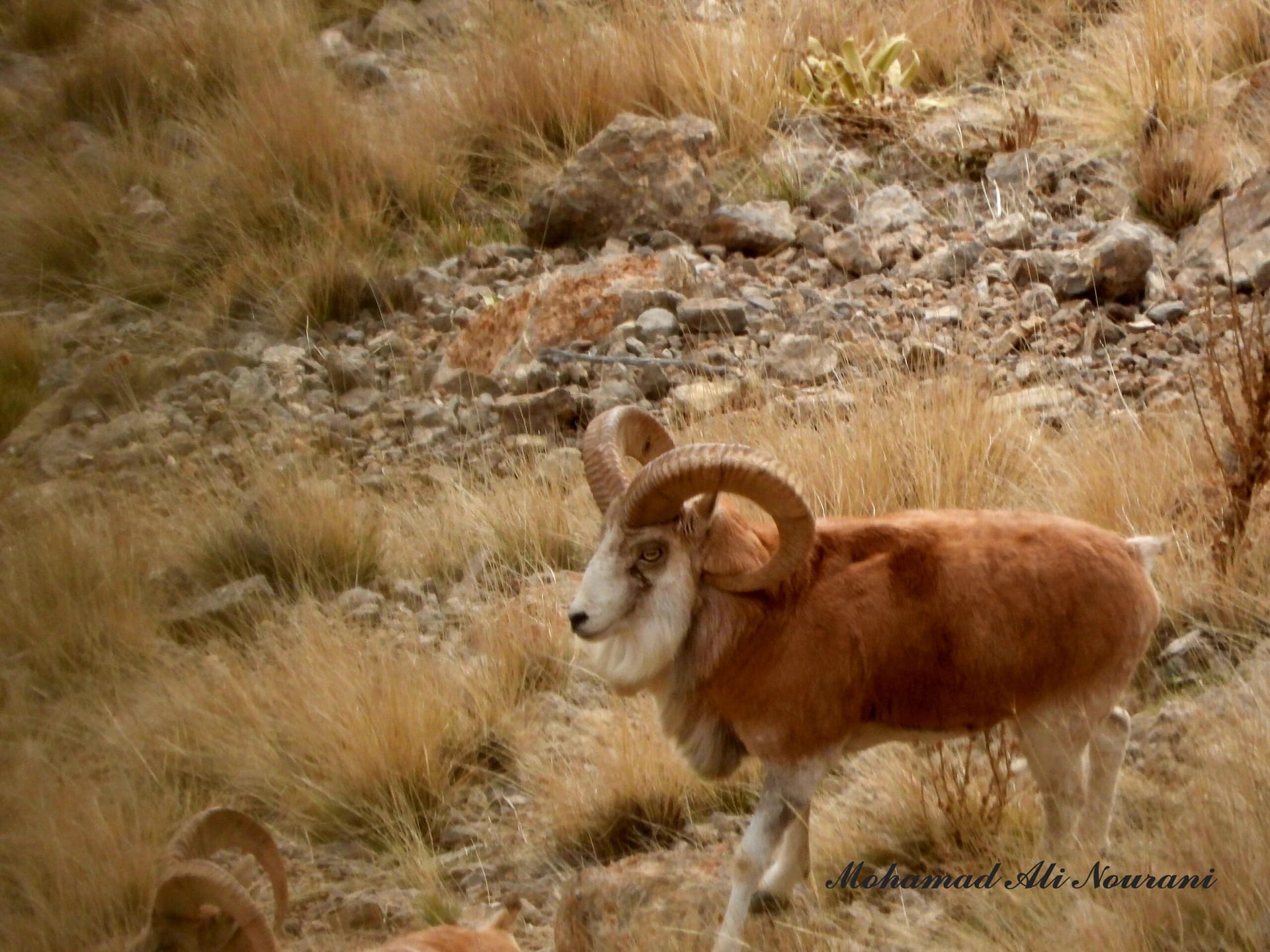
Urial Wild Sheep

Urial Wild Sheep
One of Iran's largest wild sheep, recognized by its distinctive spiral horns and its adaptation to the open hills and mountainous landscapes of northern and northeastern Iran.
Physical Characteristics
The urial is a medium- to large-sized wild sheep and is considered one of the largest wild sheep found in Iran. Its body length is approximately 150 cm, with a tail length of around 15 cm, a shoulder height of 70 to 100 cm, and a body weight ranging from 25 to 85 kg.
Adult males, or rams, are distinguished by their large, impressive horns. The horns curve backward behind the head before developing into a broad spiral, with the tips eventually turning back toward the head, creating a characteristic twisted C-shaped profile.
The horns are roughly triangular in cross-section, while females have considerably shorter and more compressed horns.
One of the longest recorded urial horns, considered a world-record specimen, was reportedly obtained from Golestan National Park.
The coat is generally short and sandy-yellow across the back during warmer months. In winter, it becomes longer and develops a darker, brownish-red coloration.
The lower body and rump are white, while elongated white hairs form a distinctive ruff around the base of the neck and chest.
Biology & Behavior
Urials are primarily diurnal animals, although they may occasionally become active at night. They are herbivorous ruminants with well-developed senses of sight and smell.
They are social animals and generally form separate groups, with adult males often gathering in ram herds while females and their young form separate groups.
Urials typically inhabit rolling hills, open foothills, and low mountainous terrain. In some regions, seasonal movements toward warmer areas occur during winter.
When threatened, urials produce a distinctive “fesh”-like alarm call, warning other members of the group of potential danger.
Their social structure and distinctive alarm call help individuals respond quickly when danger is detected within the group.
Reproduction & Life History
During the breeding season in early autumn, groups of rams and ewes come together.
Males compete for access to females by engaging in powerful horn-to-horn clashes to establish dominance and mating opportunities. Unlike some territorial species, these contests do not involve the establishment of fixed territories.
The gestation period is approximately five months, after which females generally give birth to one or two lambs.
Newborn lambs typically weigh around 3 to 4 kg and nurse for approximately 4 to 5 months.
Young urials reach maturity at approximately 2 to 3 years of age. Their lifespan in the wild is estimated at around 13 years.
Ecological Role & Predators
Urials form an important part of the mountain and foothill ecosystems they inhabit and serve as prey for several large carnivores.
In Iran, natural predators include wolves, leopards, and cheetahs. Young lambs may also be vulnerable to predation by birds of prey, hyenas, and brown bears.
Habitat & Distribution
The urial is distributed across the mountainous and hilly regions of northern and northeastern Iran.
Its range includes parts of northern and northeastern Semnan Province, Razavi Khorasan, North Khorasan, and eastern Golestan Province.
Among the best-known habitats for the species in Iran are Golestan National Park and Tandureh National Park, both of which provide important mountain and hill ecosystems for urial populations.
Conservation Status
The urial is considered a Protected Species by the Iran Department of Environment.
Internationally, it is listed in Appendix II of CITES and categorized as Vulnerable (VU) on the IUCN Red List.
Share This Article


Comments
Your Comments
Comments